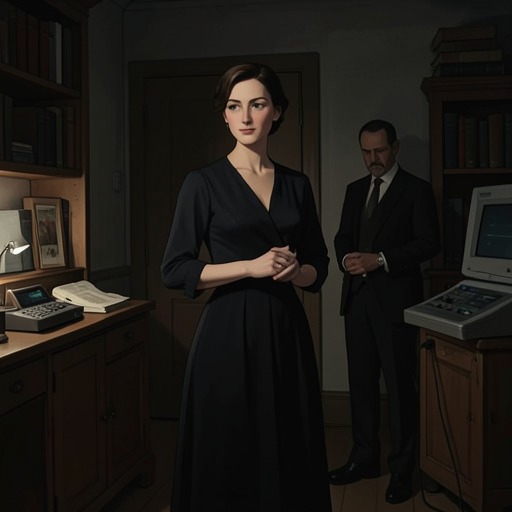
Angustias and Pepe el Romano
The House of Bernarda AlbaAngustias and Pepe el Romano are formally engaged, but their relationship is marked by an imbalance between public arrangement and private desire. The match promises Angustias marriage and a new household, yet her inheritance gives it an economic basis, Pepe appears emotionally distant, and her sisters suspect that his attention is not truly hers. As the wedding approaches, the engagement becomes a focus of rivalry and a measure of the narrow choices available to women in the village.
The Match and Its Economic Context
Angustias is the only daughter of Bernarda Alba’s first marriage, while her four sisters are her half-sisters. Her stepfather, Antonio María Benavides, leaves her substantially more money than he leaves his four natural daughters. The unequal inheritance intensifies her sisters’ resentment and helps make her a plausible marriage prospect: in their account, Pepe is courting the wealthiest woman in the household, rather than the younger sisters they consider more attractive or better suited to him.
The engagement therefore links private feeling to inheritance and social position. The sisters’ suspicion is explicit: Amelia says that Angustias is the only rich one in the house and that, after their father’s death, men are pursuing her because her estate is being divided. Magdalena contrasts the thirty-nine-year-old Angustias with Pepe, who is twenty-five, and remarks that he might more naturally have courted Amelia or the twenty-year-old Adela. Their comments are resentful and judgmental, but they identify the money surrounding the match as a central fact of its reception within the family.
The relationship also conforms to a social world in which marriage can be an arranged, economically consequential prospect, while women’s lives are constrained by domestic expectations. The play’s wider village setting treats prolonged mourning, women’s sewing and household roles, and the prospect of spinsterhood or loveless marriage as recognizable features of rural life. Angustias’s engagement thus offers a route out of unmarried dependence, but it does not establish that the match rests on mutual affection.
Wedding Preparations and Angustias’s Doubts
As the marriage draws near, the arrangements proceed publicly and rapidly. Bernarda tells Prudencia that Pepe’s family will come to ask for Angustias in three days. Prudencia asks whether Angustias has received a ring, and Angustias shows her one set with three pearls. The wedding has visible tokens and a timetable, even as the emotional meaning of the match remains uncertain.
Angustias’s unease appears in her account of Pepe’s visits. She finds him distracted and says that he speaks as if thinking about something else. When she asks what is troubling him, he answers that men have their own concerns. Bernarda tells her not to question him and instructs her to speak when he speaks and look at him when he looks at her. Her advice defines marriage as a relationship in which the wife is expected to defer rather than seek an explanation from her husband-to-be.
Angustias does not share Bernarda’s confidence that obedience will settle matters. She says that she ought to be happy but is not, and admits that she believes Pepe is concealing many things from her. She describes looking at him through the iron bars until he seems to disappear behind a cloud of dust raised by passing flocks. That image is part of her speech, not proof of a particular secret, but it gives concrete form to the distance she senses between them. When Pepe does not visit, Bernarda says that he has travelled with his mother to the capital; Martirio later asks why Angustias’s fiancé is absent that night, and Bernarda again answers that he has gone away.
Rivalry and the Hidden Attachment
The engagement becomes entangled with the sisters’ suspicions and rivalries. In the quarrel over Pepe’s portrait, Angustias enters furiously and demands to know which sister has taken the picture from beneath her pillow. Martirio denies knowing anything. When Angustias insists that the portrait had been in her room, Martirio answers with a taunt that Pepe might have slipped into the stable-yard at midnight because he likes to walk in the moonlight. The exchange places the portrait, Angustias’s private possession, at the centre of an argument over Pepe’s attention and movements.
Later, Martirio confronts Adela directly. She says that Pepe came for another woman and that Adela has put herself between them; Adela replies that he came for the money but had always set his eyes on her. Martirio insists that he will marry Angustias, while Adela tells her that Martirio knows he does not love her. The confrontation does not turn Angustias into a participant in their private contest, but it reveals how little the formal engagement resolves: the sisters dispute the difference between the marriage Pepe is expected to make and the desire they attribute to him.
The resulting pattern is not a simple opposition between a loving couple and an obstacle. The evidence identifies the economic appeal of Angustias’s inheritance, her own uncertainty about Pepe, and the competing claims made by Adela and Martirio. The engagement gives Angustias a recognized place as the intended bride, while the sisters’ exchanges make that position appear increasingly precarious and emotionally unfulfilled.
Narrative Significance
The relationship brings together inheritance, gendered expectation, and the limits of public respectability. Angustias has a financial advantage over her half-sisters, but wealth does not give her reliable knowledge of Pepe’s intentions. Bernarda’s instructions prepare her for a marriage organized around the husband’s authority, while Angustias’s doubts show the personal cost of being asked to accept the arrangement without question.
The contrast between the wedding’s outward progress and the family’s private uncertainty also contributes to the play’s broader portrayal of a society governed by reputation and silence. A ring, a scheduled visit from Pepe’s family, and the formal designation of Angustias as fiancée make the match legible to the household and village. They cannot make the sisters’ suspicions disappear. The engagement therefore functions both as a practical marriage arrangement and as the point around which concealed desires and rivalries gather.